


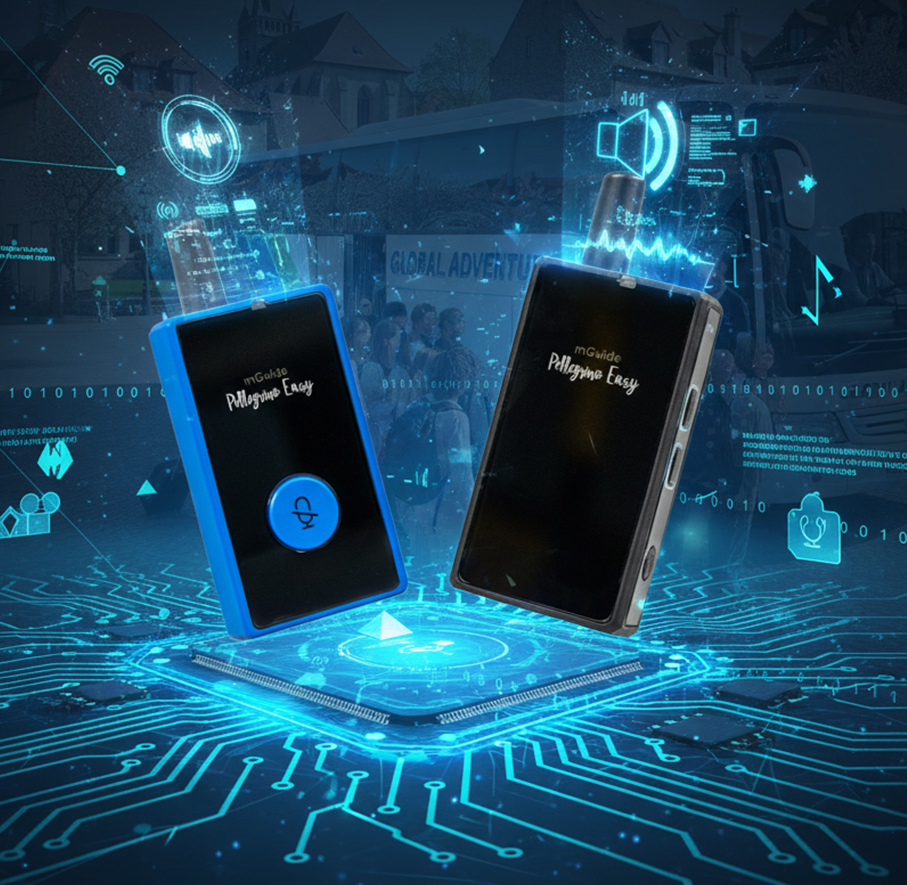
The world of technology is constantly changing, and manufacturers of communication equipment are keeping pace with these innovations. These evolutions involve both the enhancement of existing models and the adaptation to external factors that influence the way we communicate. Until now, the market has been dominated by analogue systems, such as the Okayo WT-300 or Pellegrino, which used UHF radio waves to transmit sound. However, the growing demand for modern communication technologies means that more and more traditional frequency bands are being allocated to them. As a result, analogue systems are facing greater interference, making it difficult to maintain a stable connection.
Digitalisation in Practice
The biggest advantage of digital tour guide systems is their immunity to interference and noise. Thanks to digital modulation, the sound is exceptionally clear, and signal encoding increases transmission security. What’s more, many digital models, including the Okayo OTG-102 and Okayo Wavetalk, offer extra features, such as automatic free channel search. This makes communication comfortable even when surrounded by many other devices. A huge benefit is the additional functionalities you won’t find in older, analogue systems: The WT-350D City Jungle Edition system has a switch that allows the guide to remotely give participants the floor. It’s also worth highlighting the greater energy efficiency of digital systems. They offer a similar range to their analogue counterparts but consume significantly less power. This translates into longer battery life and a smaller environmental impact.

Investing in Digitalisation
The transition from analogue to digital systems is a strategic step that brings numerous benefits to almost every industry. It positively affects work comfort and supports the ecological aspects of operations. Despite the initial compatibility challenges, investing in digitalisation is the key to stable communication in the future.


